 English (UK)
 English (US)
 Français
 Deutsch
 Español
 Italiano
 Nederlands
 简体中文

Manners vary. This is a guide to common expectations, not a rulebook, and people differ by region, age and setting. Where a venue or an authority publishes a rule, that rule comes first.
Lines and personal space
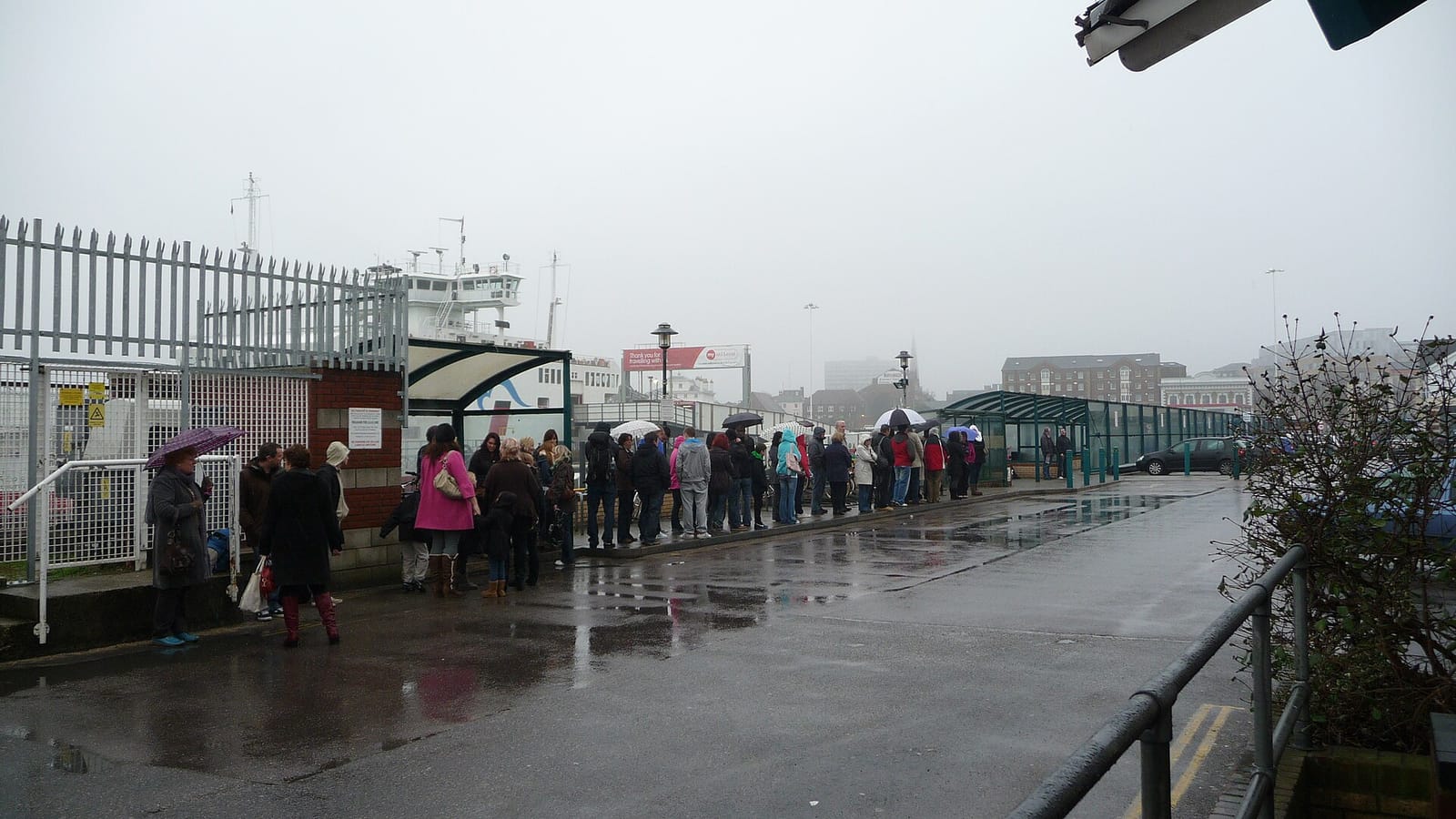
"Line" is the British word for a line of people waiting.2 Wikivoyage describes a preference for personal space: in lines, in theaters, and on public transport without allocated seats, people usually fill every row and keep as much distance as they can before sitting directly next to a stranger.1
Pubs: order at the bar, and rounds
Wikivoyage says pubs nearly always work on a "line at the bar" basis: you go to the bar to order and pay, rather than waiting for table service. Groups usually order together and settle up between themselves later. If you see another customer at the bar, the custom is to invite them to order first. Food-oriented pubs often give you a table number to quote, and your meal is brought to you or called out when ready.1 The same source mentions that some pub chains take orders through an app, so look for a sign.
If you are in a group or it is busy, Wikivoyage advises ordering drinks together in rounds, either by taking turns to buy all the drinks or by everyone contributing an agreed amount to a kitty. It is quicker for bar staff, and any pub will give you a tray for carrying several drinks if you ask.1 See our pubs guide and pub food pages.
Tipping
Wikivoyage says the UK does not have a strong tipping culture, that service charges are common in table-service restaurants, and that it is not normal to tip for drinks at the bar.1 Our money guide covers tipping and service charge in more detail.
Greetings and small talk
- A handshake is normal when meeting someone for the first time; kissing greetings between strangers are not.1
- First names are acceptable in most social situations.1
- "Sorry" is used a great deal, often instead of "excuse me". Wikivoyage's tip: do not dwell on it.1
- Salaries, and personal, political or religious convictions, are best left until you know someone better. Scottish independence, Welsh independence, Irish reunification, the Troubles and Brexit are sensitive topics for many people.1
- Asking about a person's accent can be a good way to start a conversation; imitating it is best avoided.1
For the difference between English, British and UK, see our naming explainer. Wikivoyage advises that people in Wales, Scotland, England and Northern Ireland have separate identities, and that "Northern Irish" is the safest term for people from Northern Ireland unless they say otherwise.1

Escalators and stairs
We could not find an official source for escalator etiquette, so we state no rule. At busy stations, follow the signs and any announcements. If you are standing, keep to the side that the signs or local custom suggest and keep your luggage close.
Dress
We found no national dress rule for visitors. Individual venues set their own: Wikivoyage notes that nightclubs may apply dress codes at the door, sometimes inconsistently.1 For places of worship, see the next section. Weather matters more than fashion in most places, and our packing guide helps.
Places of worship
Many cathedrals and churches are open to visitors and are also active places of worship. Westminster Abbey, for example, says it is an active place of worship, asks visitors to dress respectfully, and says there is no strict dress code for tourist visits but clothing should be modest and appropriate for a working church.3 It also recommends comfortable, flat shoes because floors are uneven in places.3 Keep your voice low, switch your phone to silent, and follow any signs. Other places have their own rules, so check the venue's website.
Photography
Rules differ from place to place and are set by each venue. As an example, Westminster Abbey welcomes personal photographs in the church but says photography is not permitted at any time during services. Video recording, flash photography, extra lighting, selfie sticks and tripods are not permitted. Photography of children or young people is prohibited without the consent of the accompanying adult, and photography is not permitted in some areas, such as the Shrine of St Edward the Confessor and St Faith's Chapel.4 Look for signs at the door of any museum, church or gallery, and ask staff if unsure.
Quiet carriages
Wikivoyage says trains have designated quiet coaches that are clearly marked. In one, you should not talk on a cell phone or play music out loud, and other travelers may remind you of the rule.1 The exact wording is set by each train company, so follow the signs on the coach. Our rail tickets and getting around pages help with planning.

Litter and the Countryside Code
The Countryside Code is published by GOV.UK for England and Wales (the page links to separate publications for Northern Ireland and Scotland). It is built around three ideas: respect everyone, protect the environment, and enjoy the outdoors.5 Its key points include:
- Take your litter home and leave no trace of your visit. Dropping litter and dumping trash are criminal offences.5
- Leave gates and property as you find them, and follow the farmer's directions when animals are being moved.5
- Do not light fires, and only have barbecues where signs say you can.5
- Keep to marked paths unless wider access is available, such as on open access land.5
- Do not block gateways or driveways when parking, and always leave access for emergency vehicles.5
- Cyclists must give way to walkers and horse riders on bridleways.5
Right to roam, nation by nation
"Right to roam" is not one law. It works differently in each nation, so check where you are walking. This is a summary of official pages; none of it is legal advice.
| Nation | What the official pages say |
|---|---|
| England | You can use public roads, sidewalks and public rights of way such as footpaths and bridleways, and you have the right to roam on open access land, which includes mountains, moors, heaths, downs, common land and some land around the England Coast Path.6 |
| Wales | Since May 2005 the Countryside and Rights of Way Act has identified open access land, and one fifth of Wales is mapped as access land where the public have a right of access on foot. It covers open country (mountain, moor, heath and downland) and registered common land.11 Natural Resources Wales publishes maps of open access land.11 |
| Scotland | The Land Reform (Scotland) Act 2003 established statutory public rights of access to land. Everyone can exercise access rights over most land and inland water, at any time of day or night, providing they do so responsibly. The Scottish Outdoor Access Code explains how.108 Access rights do not cover some places, such as sports pitches while in use.10 |
| Northern Ireland | Public access is restricted to land in public ownership that the public is invited to use, public rights of way, or places where the landowner has given permission. District councils handle local access issues.10 There are three types of public right of way: footpaths (walkers only), bridleways (walkers and horse riders) and carriageways.12 |
For walking ideas and routes, see our walks section.
Dogs and livestock
- In England and Wales the Countryside Code says to keep dogs under control and in sight, to bag dog poo and put it in any public waste bin or take it home, and to give livestock, horses and wild animals plenty of space, because their behavior can be unpredictable, particularly with young. Do not feed them.5
- GOV.UK says it is against the law to let a dog be dangerously out of control anywhere, and that the law applies to all dogs.7
- In Scotland, you can walk your dog on most land as long as you follow the Scottish Outdoor Access Code and keep your dog under proper control. Poorly controlled dogs can worry or attack livestock, disturb wildlife and scare other people. The code advises letting your dog off the lead if threatened by cattle, and bagging and binning dog poo.9
Bringing your own dog from abroad has separate rules: see traveling with pets.
Related
Back to language and etiquette, or read about health and safety and accessible travel.
Questions people ask
Do I tip in a British pub?
Wikivoyage says it is not normal to tip for drinks in a pub; people sometimes offer to buy the bartender a drink instead. See our money guide for tipping in restaurants and taxis (source 1).
Can I take photographs inside Westminster Abbey?
Westminster Abbey says personal photographs are welcome in the church, but not during services, and that video, flash, selfie sticks and tripods are not permitted. Rules differ between places, so check each one (source 4).
Is there a right to roam in the UK?
It depends on the nation. Scotland has statutory access rights over most land and inland water; England and Wales have mapped open access land; Northern Ireland has public rights of way and land with permission. See the table on this page (sources 6 to 12).