 English (UK)
 English (US)
 Français
 Deutsch
 Español
 Italiano
 Nederlands
 简体中文
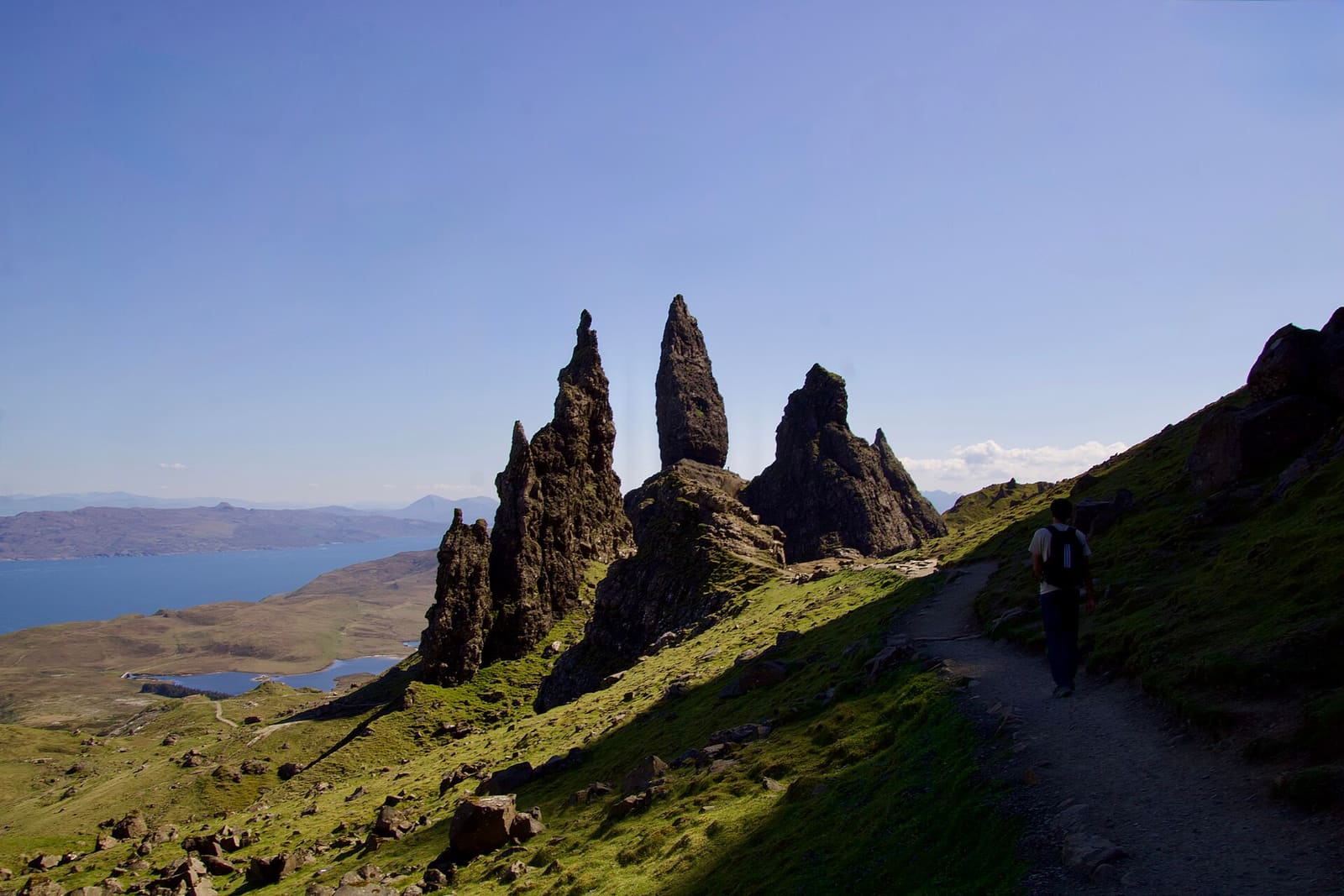

Gaelic and Scots are different languages. Gaelic is a Celtic language, and Scots is a Germanic language related to English. Place names in this guide are Gaelic unless we say otherwise. We print a pronunciation only where a numbered source prints one.
Gaelic in Scotland
The Scottish Government says Gaelic has been spoken in Scotland for more than 1,500 years and remains part of the country's cultural identity. The Gaelic Language (Scotland) Act 2005 was passed to give Gaelic greater protection and prominence, and to work towards securing its status as an official language of Scotland.1 Wikivoyage describes Gaelic as spoken mainly in the Highlands and the Western Isles.7 It also gives the name of the language, Gàidhlig, as "Gah-lig".7
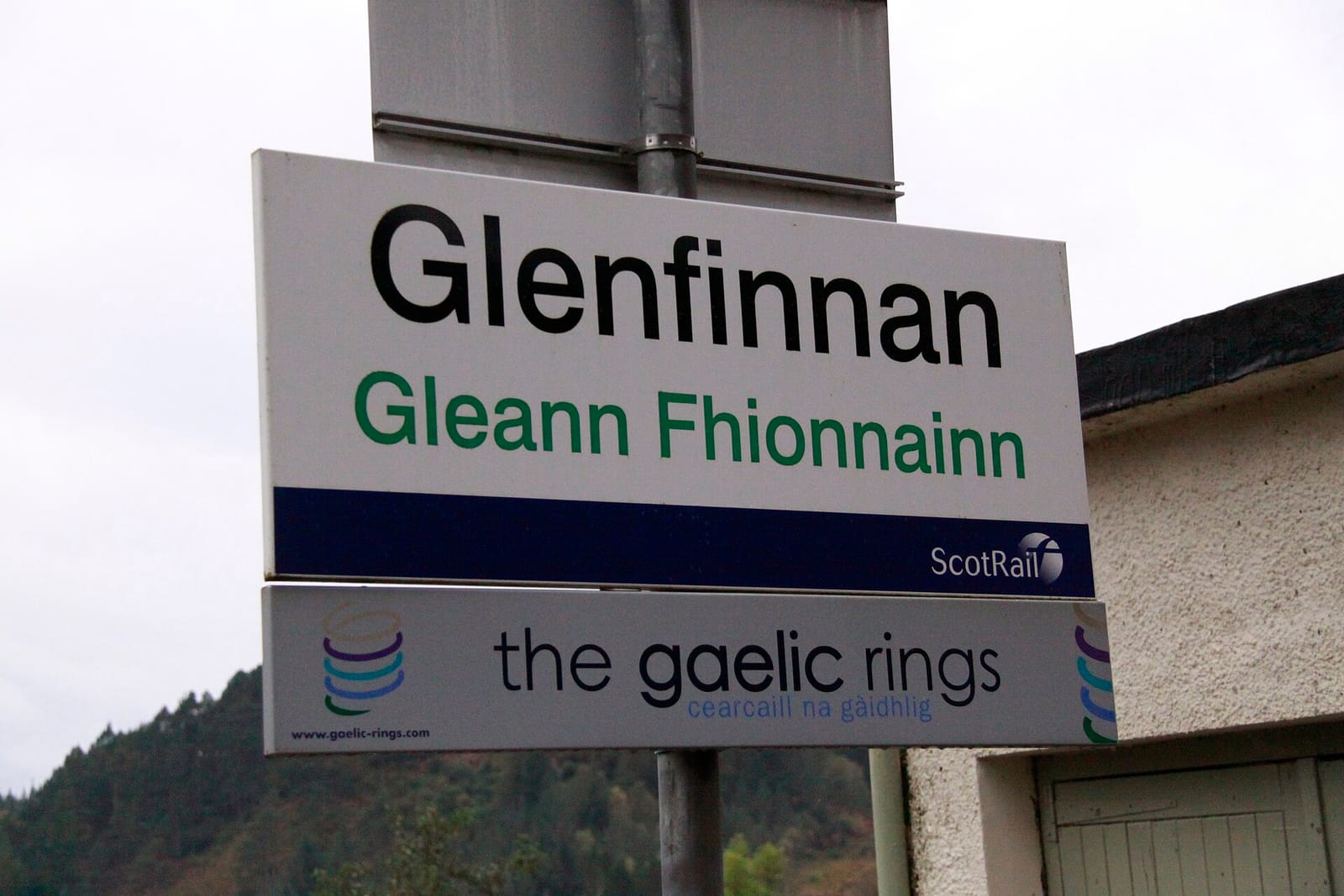
Ainmean-Àite na h-Alba describes itself as the national advisory partnership for Gaelic place-names in Scotland. It follows a published policy so that the Gaelic forms of place-names are determined in a coordinated way to a national standard.2 If you want to look up a name, the organisation runs a searchable map of Gaelic place-names (see our sources).
Inver, Strath, Ben, Loch, Kil and other elements
Many Scottish place names are Gaelic names in an English spelling. The elements below turn up again and again on maps, signposts and station boards.
| Element | Meaning |
|---|---|
| inbhir (Inver-) | river-mouth or confluence. Inverness is Inbhir Nis, the inver of the Ness; Inverbeg is 'the small river-mouth'4,3 |
| obar (Aber-) | an equivalent of inbhir borrowed from Brittonic or Pictish, as in Aberfoyle (Obar Phuill), 'mouth of the muddy stream'3 |
| srath (Strath-) | river valley. Strathyre comes from Srath Eadhair, 'strath of cornland'4,3 |
| beinn (Ben) | mountain4 |
| loch, lochan | loch, and a wee loch. A different word, lòch, is an ancient adjective meaning 'dark' or 'black'4,3,5 |
| cill (Kil-) | church. Killin is Cill Fhinn, 'fair church'; Kilmun is Cill Mhunna, 'Munna's church'3,4 |
| baile | settlement. Baile Mo Thatha is generally given as 'the settlement of Mo Thatha' (Balmaha)3 |
| àird (Ard-) | height or headland. Ardnamurchan is Àird nam Murchan, 'the height of the seals'5,3 |
| ceann (Kin-) | head. Kinlochrannoch is Ceann Loch Raineach, the head of Loch Rannoch4 |
| tulach (Tulloch) | hill4 |
Some examples show how the pieces join. Inverness is Inbhir Nis, "the inver of the Ness".4 Ardnamurchan is "the height of the seals", a name that appears in a Life of St Columba written around 700 AD, according to a Historic Environment Scotland guest post by Ainmean-Àite na h-Alba.5 Kinlochrannoch is the head of Loch Rannoch.4
Names can have more than one history. The Loch Lomond & The Trossachs National Park Authority notes that Aber- or Obar- is a borrowing from Brittonic or Pictish, equivalent to the more common Gaelic inbhir,3 which is why you see both Aber- and Inver- on Scottish maps. The same page gives the Gaelic and English forms of Balquhidder, Balmaha and others, and says in some cases the meaning is uncertain.3

Gaelic names with a printed pronunciation
The National Park Authority prints a respelling beside many Gaelic forms, using capitals for the stressed syllable. We reproduce a few of them as printed.
| Gaelic form (English name) | Meaning |
|---|---|
| Cill Fhinn (Killin)Printed pronunciation: kil EEN | fair church3 |
| Cill Mhunna (Kilmun)Printed pronunciation: kil VOONuh | Munna's church3 |
| An t-Inbhir Beag (Inverbeg)Printed pronunciation: un tchinivur BAYK | the small river-mouth3 |
| Am Bealach (Balloch)Printed pronunciation: um BYALuch | the pass3 |
| Lus (Luss)Printed pronunciation: looss | from Gleann Luis, 'herb glen'3 |
| Calasraid (Callander)Printed pronunciation: KALusratch | harbour street3 |
Gaelic on signs and in greetings
These words come from Wikivoyage's Scottish Gaelic phrasebook, which lists common signs and basic greetings.6
| Gaelic | English |
|---|---|
| Fàilte | welcome6 |
| Fosgailte | open6 |
| Dùinte | closed6 |
| Inntrinn | entrance6 |
| Doras a-mach | exit6 |
| Slighe a-mach | way out6 |
| Stob and Giob | push and pull6 |
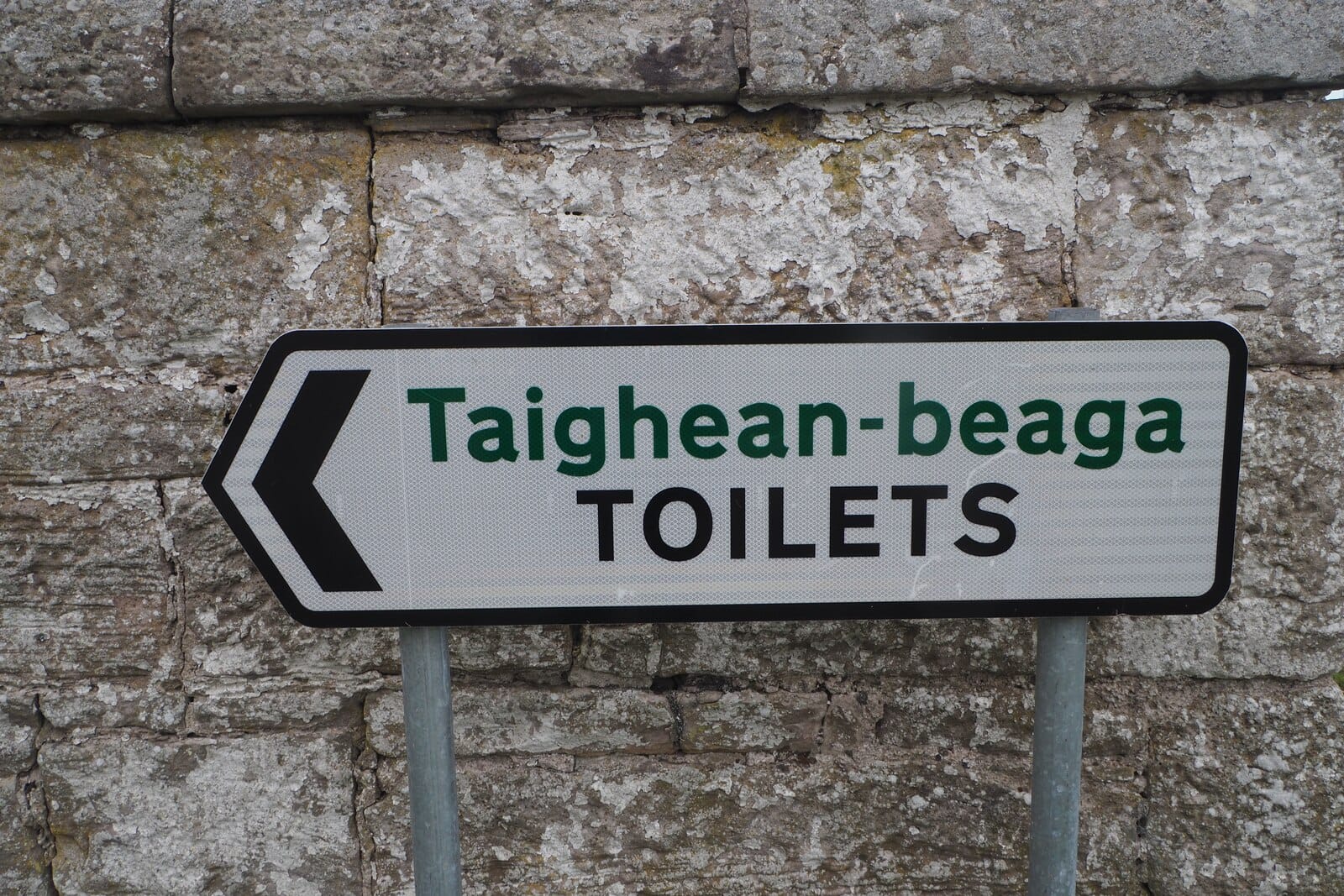
| Taigh-beag | toilet6 |
| Toirmisgte | forbidden6 |
| HalòPrinted pronunciation: ha-LAW | hello6 |
| Madainn mhathPrinted pronunciation: MAT-een vah | good morning6 |
| Tapadh leatPrinted pronunciation: TAH-puh let | thank you (informal; 'Tapadh leibh' is the formal form)6 |
| Slàinte | cheers6 |
| GàidhligPrinted pronunciation: Gah-lig | Scottish Gaelic, the language7 |

Scots
The Scottish Government describes Scots as an important part of Scotland's culture and heritage, found in songs, poetry and literature as well as daily use in communities. In the 2022 census, 1,508,540 people reported that they could speak Scots.8 A senior editor at Dictionaries of the Scots Language says she hopes its book of favourite words will help dispel the myths that Scots is a dead language or "slang".9
Wikivoyage says Scots is more or less intelligible to native English speakers, especially in writing, and that speakers will usually use English with outsiders.711 You will hear Scots words mixed into English speech.
| Scots word | Meaning |
|---|---|
| bairn | child7 |
| ken | know7 |
| tatties | potatoes7 |
| bridie | meat pastry7 |
| wee | small11 |
| kirk | church11 |
| dreich | dreary10 |
| dux | top pupil in the class9 |
| onding | a heavy fall of rain or snow9 |
Two of these words also appear on maps: Wikivoyage lists kirk as meaning church in Scotland, and loch as the Scottish word for a lake.11
Related
See our Highlands guide, Edinburgh and Glasgow, read about Welsh, or go back to language and etiquette.