 English (UK)
 English (US)
 Français
 Deutsch
 Español
 Italiano
 Nederlands
 简体中文

This page informs and links. It does not replace official guidance, and rules, fees and contact details change. Where a figure is given it is exactly as the official page stated on 25 Oct 2026: check the page before you travel. For London see Step-free London.
Rail
- Passenger Assist. National Rail says any train company can organise help for your whole journey, even across several services. You can book through the Passenger Assistance app or website, by calling 0800 022 3720 and choosing option 1, or by text to 60083 (Monday to Friday, 09:00 to 17:00). It advises booking as far ahead as possible and accepts requests up to 2 hours before your journey.1 You can also travel without booking and ask station staff or use a Help Point.2
- Disabled Persons Railcard. The Railcard site says it gives one third off tickets for you and one adult companion, for anyone with a disability on its eligibility checklist. On 25 Oct 2026 it listed £20 for one year and £54 for three years.3 Check the site for eligibility, exclusions and the current price.
- Assistance Dog Travel Scheme. National Rail says all trained assistance dogs are welcome and the scheme provides a reusable “Assistance Dog Under Seat” card that asks other passengers to keep the space free.2
- Sunflower lanyard. National Rail says every train company in Britain accepts it as a discreet sign that you may need extra help; you can get one at your local station in England, Scotland or Wales.2
For step-free routes inside London see our journey planner. For routes between regions see getting between regions.
National Rail’s step-free category for each main station (A means step-free access to all platforms) is listed on rail gateway stations and on each train route page.
Air
The Civil Aviation Authority says that you are legally entitled to assistance, free of charge, when flying from a UK airport on any airline, or to a UK airport on a UK or EU airline, and that help is available from arrival at the airport to reaching your destination.4 Ask your airline, travel agent or tour operator when you book or at least 48 hours before departure, and keep written confirmation. The airport provides help from drop-off to the gate; the airline helps with boarding, your seat and baggage.5 Each airport publishes its own assistance page: check the airport’s site for where to meet staff.
Step-free notes for the links into town from each airport are on the airport pages, and the options are compared on airport transfers.
Coach and taxi
- National Express. Its accessibility page recommends contacting the Assisted Travel Team (03717 81 81 81, or its online form) at least 36 hours before you travel where possible, and says it will still make reasonable efforts at shorter notice. Assistance dogs are welcome and pre-booking is recommended.6 Other operators have their own policies: check with them.
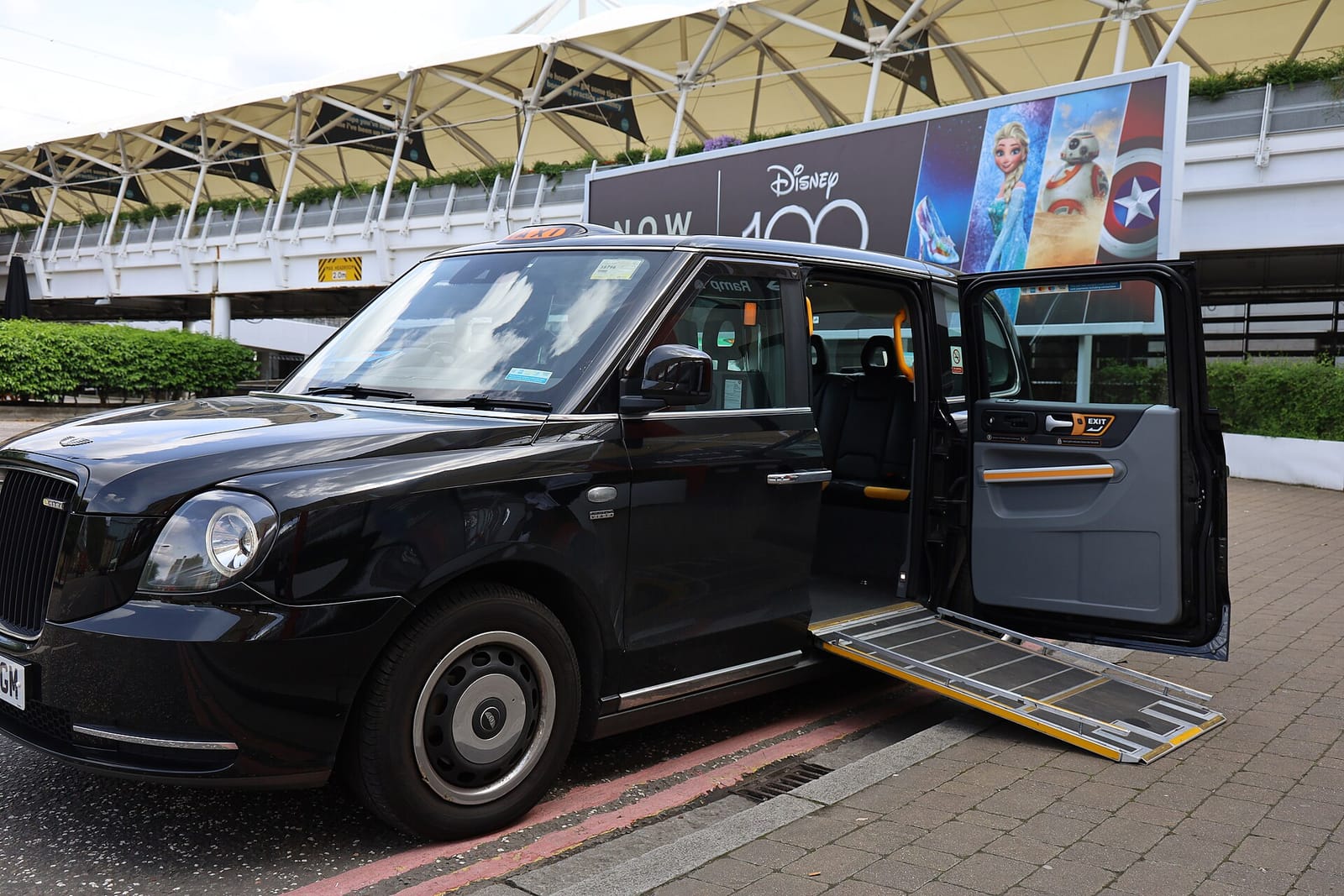
- Taxis and minicabs. GOV.UK says an assistance dog must be allowed to travel with you if you have a mobility or dexterity impairment or epilepsy; drivers with a medical exemption show a notice of exemption. In some areas, mainly larger cities, licensed taxis have to be wheelchair accessible, and the local council’s taxi licensing office can help you find one.11

Driving and Blue Badge
GOV.UK’s Blue Badge application page covers applying and renewing, and does not mention visitors from abroad; Northern Ireland has a separate route through nidirect.7 The England rules page says to display the badge where it can be read through the windscreen, to use the parking clock where there is a time limit, and that badge holders may park on single or double yellow lines for up to 3 hours (not where loading is restricted).8 That guidance does not address foreign badges in England.
- Scotland. mygov.scot says visitors from outside the UK may be able to use their home-country disability parking permit and should check with the local council where they plan to park.9
- London red routes. TfL describes reserved bays and when you may stop on red lines for a Blue Badge holder; its page does not mention overseas badges.10 Check TfL and the borough before driving into central London.
- Wales and Northern Ireland. We did not read an official visitor page for these: ask the local council, or check nidirect (opens in new tab) for Northern Ireland.
Private car parks set their own terms, and badge concessions differ by council: always read the signs. Check gov.uk and the council for the place where you will park.
Toilets
- Changing Places. The Changing Places Consortium runs a national toilet map and finder (opens in new tab) with filters for certification level, venue type and whether a toilet is open now. The page showed 2,697 registered toilets when we read it.12 VisitBritain describes them as offering facilities such as adult-sized hoists.13
- RADAR key. VisitBritain mentions RADAR keys as opening over 10,000 accessible toilets.13 The Disability Rights UK page on the key refused our request (see Sources), so check their page (opens in new tab) for where to get one and which toilets it opens.
Hidden disabilities and sensory needs
- Access Card. The Nimbus Access Card is a photo ID card that uses symbols to show access needs, recognised at venues listed on its site; it listed £15 for 3 years on 25 Oct 2026.14 The site names no specific venues on its home page, so confirm a venue accepts it before you rely on it.
- Sunflower lanyard. Accepted by every train company in Britain.2 VisitBritain says staff at many attractions and travel services recognise it.13
- Quiet hours and quiet spaces. The National Autistic Society gives examples of what venues can offer: quiet hours with dimmer lights and less background noise, signposted quiet spaces, and relaxed performances with lower sound and freer movement in the auditorium.16 These vary by venue and date. Check the venue’s access page. VisitBritain also points to sensory rooms at busy locations and Network Rail’s autism-friendly travel guide.13
Hearing loops
RNID says hearing loops are used in many public places, including some theatres, shops and reception desks, that venues with one display the “T” sign, and that you may need to ask staff to check it is switched on. Your hearing aid must be set to its loop setting.15 VisitBritain refers to assistive listening systems in venues.13 We do not hold loop data for individual venues: the venue’s access page is the place to check.

Assistance dogs
On trains see the Assistance Dog Travel Scheme above.2 National Express welcomes assistance dogs and recommends pre-booking.6 In taxis, GOV.UK sets the rule described above.11 If you are bringing a guide or assistance dog from abroad, see bringing a pet to Great Britain: GOV.UK says separate guidance covers guide and assistance dogs.
Access at a glance
We hold a step-free report for 748 of 9,192 places in our guides (8%), for 133 of 1,683 places to stay (8%), and access information for 145 of 268 theatres (54%). A “report” is a step-free flag from OpenStreetMap contributors or the venue’s own page. Coverage is uneven: a blank means we hold no report, not that a place is inaccessible.
| Destination | Places with a step-free report | Stays with a report | Theatres with access information | Where to look |
|---|---|---|---|---|
| London | 369 of 1,203 (31%) | 77 of 253 | 72 of 167 | Step-free London |
| Aberdeen and Aberdeenshire | 3 of 131 (2%) | 1 of 28 | no theatre directory | Stay guide; on the Aberdeen and Aberdeenshire eat and stay pages use the “Step-free (reported)” chip |
| Anglesey | 0 of 51 (0%) | 0 of 13 | no theatre directory | Stay guide; on the Anglesey eat and stay pages use the “Step-free (reported)” chip |
| Bath | 43 of 195 (22%) | 5 of 42 | 4 of 5 | Stay guide; on the Bath eat and stay pages use the “Step-free (reported)” chip |
| Birmingham | 8 of 154 (5%) | 1 of 15 | no theatre directory | Stay guide; on the Birmingham eat and stay pages use the “Step-free (reported)” chip |
| Blackpool and the Lancashire coast | 6 of 81 (7%) | 1 of 15 | no theatre directory | Stay guide; on the Blackpool and the Lancashire coast eat and stay pages use the “Step-free (reported)” chip |
| Brighton & Hove | 1 of 209 (0%) | 0 of 28 | no theatre directory | Stay guide; on the Brighton & Hove eat and stay pages use the “Step-free (reported)” chip |
| Bristol | 23 of 247 (9%) | 5 of 26 | 5 of 6 | Stay guide; on the Bristol eat and stay pages use the “Step-free (reported)” chip |
| Cambridge | 19 of 186 (10%) | 3 of 20 | 5 of 5 | Stay guide; on the Cambridge eat and stay pages use the “Step-free (reported)” chip |
| Canterbury & Kent | 11 of 217 (5%) | 2 of 34 | no theatre directory | Stay guide; on the Canterbury & Kent eat and stay pages use the “Step-free (reported)” chip |
| Cardiff | 8 of 154 (5%) | 2 of 19 | no theatre directory | Stay guide; on the Cardiff eat and stay pages use the “Step-free (reported)” chip |
| Cornwall | 1 of 207 (0%) | 0 of 37 | 2 of 4 | Stay guide; on the Cornwall eat and stay pages use the “Step-free (reported)” chip |
| Coventry | 3 of 31 (10%) | 0 of 6 | no theatre directory | Stay guide; on the Coventry eat and stay pages use the “Step-free (reported)” chip |
| Devon | 0 of 276 (0%) | 0 of 61 | no theatre directory | Stay guide; on the Devon eat and stay pages use the “Step-free (reported)” chip |
| Edinburgh | 29 of 411 (7%) | 7 of 78 | 6 of 12 | Stay guide; on the Edinburgh eat and stay pages use the “Step-free (reported)” chip |
| Glasgow | 18 of 306 (6%) | 4 of 25 | 7 of 9 | Stay guide; on the Glasgow eat and stay pages use the “Step-free (reported)” chip |
| Gloucester | 1 of 33 (3%) | 0 of 6 | no theatre directory | Stay guide; on the Gloucester eat and stay pages use the “Step-free (reported)” chip |
| Hereford | 0 of 30 (0%) | 0 of 6 | no theatre directory | Stay guide; on the Hereford eat and stay pages use the “Step-free (reported)” chip |
| Ironbridge Gorge | 0 of 0 (n/a) | 0 of 0 | no theatre directory | Stay guide; on the Ironbridge Gorge eat and stay pages use the “Step-free (reported)” chip |
| Islay and Jura | 0 of 41 (0%) | 0 of 8 | no theatre directory | Stay guide; on the Islay and Jura eat and stay pages use the “Step-free (reported)” chip |
| Isle of Arran | 0 of 42 (0%) | 0 of 14 | no theatre directory | Stay guide; on the Isle of Arran eat and stay pages use the “Step-free (reported)” chip |
| Isle of Bute | 0 of 31 (0%) | 0 of 6 | no theatre directory | Stay guide; on the Isle of Bute eat and stay pages use the “Step-free (reported)” chip |
| Isles of Scilly | 0 of 45 (0%) | 0 of 11 | no theatre directory | Stay guide; on the Isles of Scilly eat and stay pages use the “Step-free (reported)” chip |
| Leeds | 17 of 139 (12%) | 1 of 17 | no theatre directory | Stay guide; on the Leeds eat and stay pages use the “Step-free (reported)” chip |
| Leicester | 1 of 33 (3%) | 0 of 6 | no theatre directory | Stay guide; on the Leicester eat and stay pages use the “Step-free (reported)” chip |
| Lincoln | 1 of 32 (3%) | 0 of 7 | no theatre directory | Stay guide; on the Lincoln eat and stay pages use the “Step-free (reported)” chip |
| Lindisfarne (Holy Island) | 0 of 41 (0%) | 0 of 6 | no theatre directory | Stay guide; on the Lindisfarne (Holy Island) eat and stay pages use the “Step-free (reported)” chip |
| Liverpool | 0 of 258 (0%) | 0 of 30 | 7 of 8 | Stay guide; on the Liverpool eat and stay pages use the “Step-free (reported)” chip |
| Llangollen and Pontcysyllte | 0 of 0 (n/a) | 0 of 0 | no theatre directory | Stay guide; on the Llangollen and Pontcysyllte eat and stay pages use the “Step-free (reported)” chip |
| Lundy | 0 of 41 (0%) | 0 of 6 | no theatre directory | Stay guide; on the Lundy eat and stay pages use the “Step-free (reported)” chip |
| Manchester | 0 of 335 (0%) | 0 of 47 | 7 of 10 | Stay guide; on the Manchester eat and stay pages use the “Step-free (reported)” chip |
| Mull and Iona | 0 of 46 (0%) | 0 of 12 | no theatre directory | Stay guide; on the Mull and Iona eat and stay pages use the “Step-free (reported)” chip |
| Newcastle and Gateshead | 23 of 183 (13%) | 2 of 19 | no theatre directory | Stay guide; on the Newcastle and Gateshead eat and stay pages use the “Step-free (reported)” chip |
| Norfolk and the Broads | 0 of 205 (0%) | 0 of 33 | no theatre directory | Stay guide; on the Norfolk and the Broads eat and stay pages use the “Step-free (reported)” chip |
| North Coast 500 | 0 of 58 (0%) | 0 of 18 | no theatre directory | Stay guide; on the North Coast 500 eat and stay pages use the “Step-free (reported)” chip |
| Northern Ireland | 7 of 253 (3%) | 0 of 55 | 5 of 7 | Stay guide; on the Northern Ireland eat and stay pages use the “Step-free (reported)” chip |
| Nottingham | 3 of 119 (3%) | 0 of 12 | no theatre directory | Stay guide; on the Nottingham eat and stay pages use the “Step-free (reported)” chip |
| Orkney | 2 of 160 (1%) | 2 of 51 | no theatre directory | Stay guide; on the Orkney eat and stay pages use the “Step-free (reported)” chip |
| Oxford | 9 of 169 (5%) | 0 of 26 | 6 of 8 | Stay guide; on the Oxford eat and stay pages use the “Step-free (reported)” chip |
| Portsmouth and Southampton | 22 of 156 (14%) | 1 of 19 | no theatre directory | Stay guide; on the Portsmouth and Southampton eat and stay pages use the “Step-free (reported)” chip |
| Salisbury & Stonehenge | 4 of 115 (3%) | 0 of 16 | no theatre directory | Stay guide; on the Salisbury & Stonehenge eat and stay pages use the “Step-free (reported)” chip |
| Sheffield | 10 of 115 (9%) | 1 of 4 | no theatre directory | Stay guide; on the Sheffield eat and stay pages use the “Step-free (reported)” chip |
| Shetland | 4 of 91 (4%) | 1 of 25 | no theatre directory | Stay guide; on the Shetland eat and stay pages use the “Step-free (reported)” chip |
| Shrewsbury | 0 of 40 (0%) | 0 of 7 | no theatre directory | Stay guide; on the Shrewsbury eat and stay pages use the “Step-free (reported)” chip |
| St Andrews and Fife | 9 of 150 (6%) | 1 of 25 | no theatre directory | Stay guide; on the St Andrews and Fife eat and stay pages use the “Step-free (reported)” chip |
| Stirling and the Trossachs | 6 of 68 (9%) | 1 of 15 | no theatre directory | Stay guide; on the Stirling and the Trossachs eat and stay pages use the “Step-free (reported)” chip |
| Stratford & Warwickshire | 29 of 174 (17%) | 4 of 25 | no theatre directory | Stay guide; on the Stratford & Warwickshire eat and stay pages use the “Step-free (reported)” chip |
| The Cotswolds | 0 of 132 (0%) | 0 of 32 | 2 of 2 | Stay guide; on the the Cotswolds eat and stay pages use the “Step-free (reported)” chip |
| The Jurassic Coast | 4 of 181 (2%) | 0 of 37 | 5 of 6 | Stay guide; on the the Jurassic Coast eat and stay pages use the “Step-free (reported)” chip |
| The Lake District | 0 of 232 (0%) | 0 of 63 | 2 of 2 | Stay guide; on the the Lake District eat and stay pages use the “Step-free (reported)” chip |
| The New Forest | 0 of 48 (0%) | 0 of 9 | no theatre directory | Stay guide; on the The New Forest eat and stay pages use the “Step-free (reported)” chip |
| The Outer Hebrides | 0 of 122 (0%) | 0 of 42 | no theatre directory | Stay guide; on the The Outer Hebrides eat and stay pages use the “Step-free (reported)” chip |
| The Peak District | 0 of 185 (0%) | 0 of 37 | 1 of 1 | Stay guide; on the the Peak District eat and stay pages use the “Step-free (reported)” chip |
| The Scottish Highlands | 6 of 204 (3%) | 1 of 59 | 1 of 3 | Stay guide; on the the Scottish Highlands eat and stay pages use the “Step-free (reported)” chip |
| The South Downs | 1 of 52 (2%) | 0 of 6 | no theatre directory | Stay guide; on the The South Downs eat and stay pages use the “Step-free (reported)” chip |
| Wales | 6 of 282 (2%) | 2 of 80 | 5 of 9 | Stay guide; on the Wales eat and stay pages use the “Step-free (reported)” chip |
| Windsor | 1 of 55 (2%) | 1 of 9 | no theatre directory | Stay guide; on the Windsor eat and stay pages use the “Step-free (reported)” chip |
| Worcester | 5 of 29 (17%) | 0 of 6 | no theatre directory | Stay guide; on the Worcester eat and stay pages use the “Step-free (reported)” chip |
| York | 23 of 176 (13%) | 4 of 27 | 3 of 4 | Stay guide; on the York eat and stay pages use the “Step-free (reported)” chip |
| Yorkshire | 12 of 232 (5%) | 3 of 44 | no theatre directory | Stay guide; on the Yorkshire eat and stay pages use the “Step-free (reported)” chip |
Computed at build time from the area guides: London from the access files (a status of yes, limited or no counts as a report) and the step-free tag; other destinations from the step-free tag on things to do, eating and drinking, and stays, and from each theatre’s access field. Read how we handle access on our own site in our accessibility statement.
Where to stay
Our where to stay pages compare areas for step-free needs and mark stays that carry a reported step-free flag. Ask the property directly about steps, lifts, bathrooms and parking before you book. VisitBritain’s Accessible Britain guide (opens in new tab) points to accommodation search tools with filters for mobility and hearing needs.13 See also travelling with children and travelling with pets.
Questions people ask
Do I have to book Passenger Assist?
National Rail advises booking as far ahead as possible and accepts requests up to 2 hours before your journey starts. Its accessible travel page also says you can travel without booking and ask a member of staff or use a Help Point for short-notice help. Check the National Rail pages for the current wording.
Can I use my overseas disabled parking badge in Britain?
It depends on where you park. mygov.scot says visitors from outside the UK may be able to use their home-country permit in Scotland and to check with the local council. The gov.uk Blue Badge pages we read do not cover foreign badges, so ask the council for the place you will park, and see the TfL page for London red routes. Check gov.uk and the council before you travel.
Does Britlens say which places are step-free?
Only where we hold a report, from OpenStreetMap contributors or the venue’s own page. The table on this page shows how many places have one. A place with no flag is not ruled out: we simply hold no report.