 English (UK)
 English (US)
 Français
 Deutsch
 Español
 Italiano
 Nederlands
 简体中文
Westminster & Whitehall
Royal London: St James's to Whitehall
From Green Park to Buckingham Palace, Horse Guards and Westminster Abbey.
- Distance 4.0 km · 2.5 miles
- Walking time 55 min Allow 1 h 15 min for stops
- Stops8 Green Park to Westminster
- Terrain Flat
- Step-freeCheck routeNot verified for this walk
Take this walk offline
The route
A walk through ceremonial London: St James's Palace, the Mall and Buckingham Palace, across St James's Park to Horse Guards Parade, then along Whitehall past the Banqueting House, Downing Street and the Cenotaph to Westminster Abbey.
The interactive map needs JavaScript. The stops are listed below.
Stops
- Start: Green Park
- End: Westminster
Distance and times come from a pedestrian route between the stops. Allow extra time for stops, and check for temporary closures.
Route and map data © OpenStreetMap contributors (ODbL). Walking routes by the FOSSGIS OSRM service, saved 2026-10-18. Spotted a mistake? Fix the map.
Saved. Plan your days in My trip
Google Maps chooses its own footpaths between the stops, so its line may differ slightly from the map above. The GPX file has our route and every stop as waypoints, for use in a walking or hiking app.
8 stops, in order
Each caption is a short fact; check opening times and tickets on the official site before you go.
-
Stop 1 · Palace
St James's Palace
Royal palace built for Henry VIII in the 1530s.
890 m to the next stop
-
Stop 2 · Palace
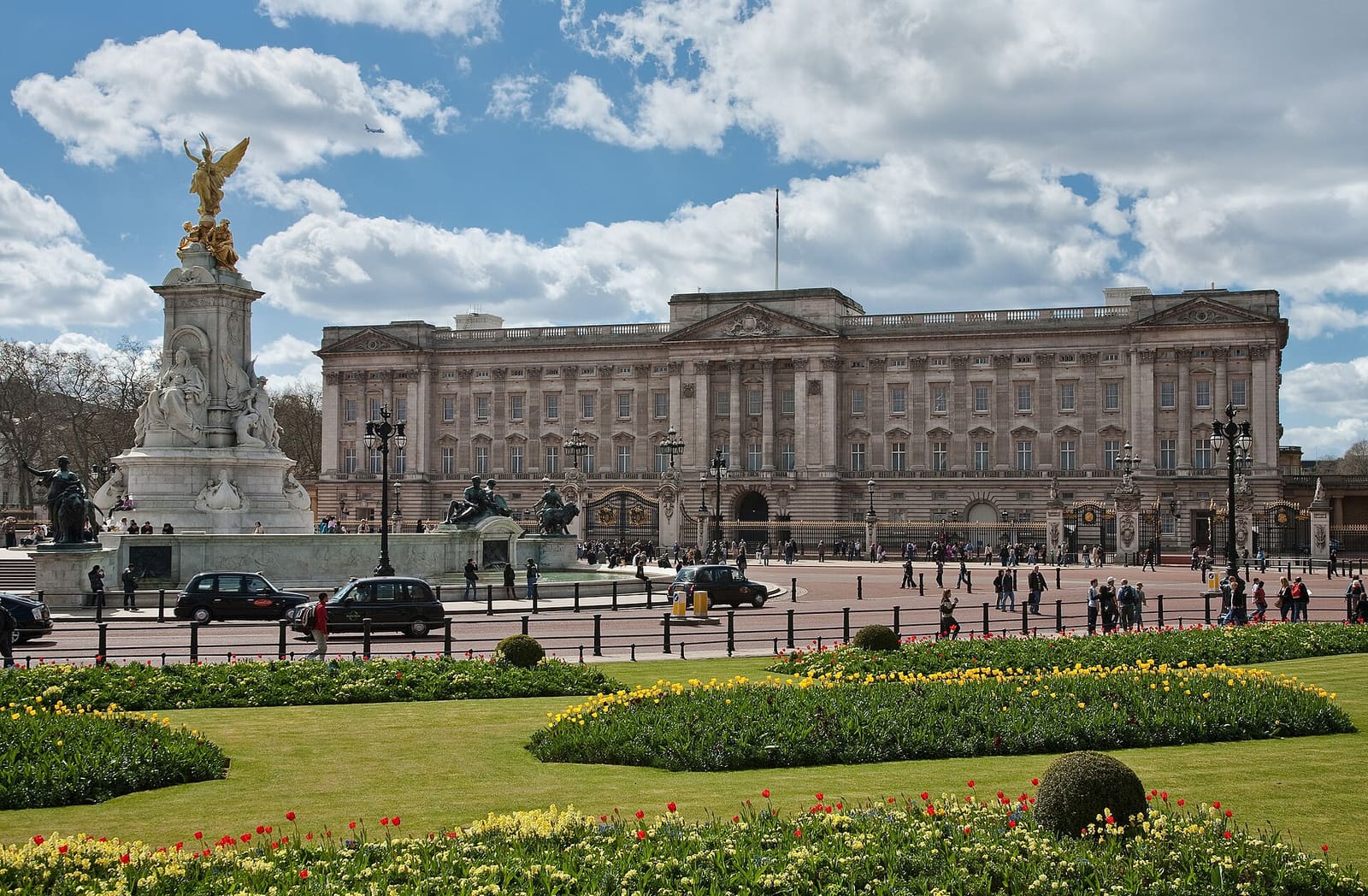
Buckingham Palace
The monarch's official London residence.
840 m to the next stop
-
Stop 3 · Park
St James's Park
Royal park with a lake, between Buckingham Palace and Horse Guards.
420 m to the next stop
-
Stop 4 · Parade ground
Horse Guards Parade
Ceremonial parade ground beside Whitehall.
180 m to the next stop
-

Stop 5 · Attraction
Banqueting House
Surviving part of the old Palace of Whitehall, on Whitehall.
190 m to the next stop
-

Stop 6 · Attraction
10 Downing Street
Official residence of the Prime Minister, behind security gates.
70 m to the next stop
-

Stop 7 · Historic site
The Cenotaph
National war memorial in the middle of Whitehall.
450 m to the next stop
-
Stop 8 · Attraction
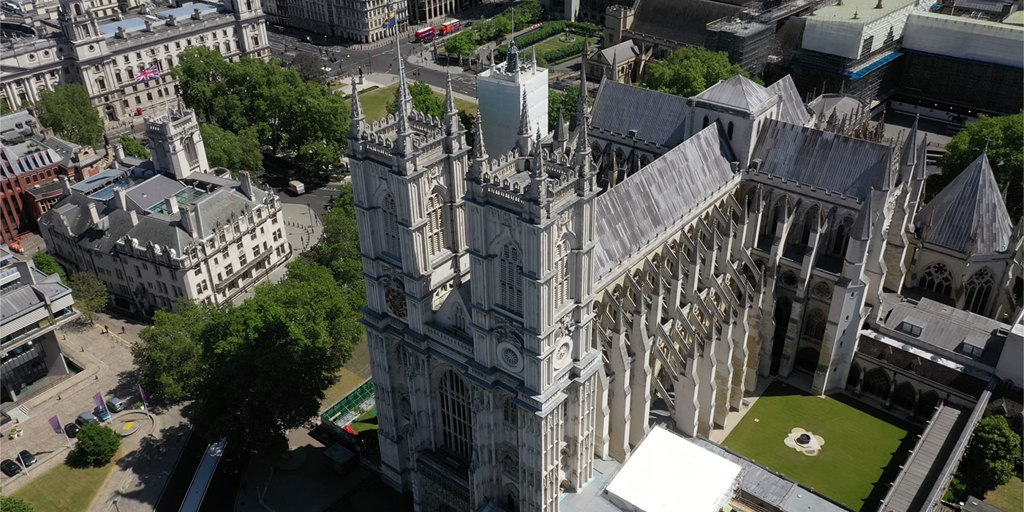
Westminster Abbey
Gothic abbey church where coronations take place.
430 m to Westminster station
Read the guide
A short note for each stop, written to be read or recorded as an audio walk. Audio is not available for this walk yet.
Introduction
Read the guide
This walk goes through ceremonial London. It starts at Green Park station, passes St James's Palace, and reaches Buckingham Palace along the Mall. You then cross St James's Park to Horse Guards Parade and follow Whitehall past the Banqueting House, Downing Street and the Cenotaph. It ends at Westminster Abbey, by Westminster station. Ceremonies and openings change, so check before you go.
Stop 1: St James's Palace
Read the guide
Henry the Eighth built St James's Palace, largely between 1531 and 1536, on the site of the Hospital of St James. It is made of red brick. The gatehouse and the Chapel Royal survive from his time. It was a home to English monarchs for over three hundred years, and William the Fourth was the last sovereign to live here. A fire in 1809 destroyed much of the east and south ranges. It is still a working palace, and the Accession Council meets here after a monarch dies. Next stop: Buckingham Palace.
Sources for this stop
Stop 2: Buckingham Palace
Read the guide
George the Third bought Buckingham House in 1761 as a family home for Queen Charlotte. Fourteen of his fifteen children were born there. In the 1820s George the Fourth had the architect John Nash turn it into a palace. The cost climbed to nearly half a million pounds, and Nash lost his job. In July 1837 Queen Victoria became the first sovereign to live here. The palace has seven hundred and seventy-five rooms. Next stop: St James's Park.
Sources for this stop
Stop 3: St James's Park
Read the guide
This land was a marshy water meadow, named after a leper hospital. In 1532 Henry the Eighth added it to his deer parks and fenced it off. After Charles the Second came to the throne in 1660, he had the French landscaper André Mollet redesign it, with a canal of almost half a mile. In the 1820s John Nash replaced the canal with the curving lake you see now. Pelicans arrived in 1664 as a gift from the Russian Ambassador. Next stop: Horse Guards Parade.
Stop 4: Horse Guards Parade
Read the guide
Horse Guards Parade is the ceremonial parade ground where Trooping the Colour is held on the King's official birthday in June. The Horse Guards building has a clock tower over an archway, which is still the official entrance to St James's and Buckingham Palace. It dates from the eighteenth century, and William Kent designed it. Mounted troopers of the King's Life Guard stand outside. The Household Cavalry was formed in 1661, on the orders of Charles the Second. Next stop: Banqueting House.
Stop 5: Banqueting House
Read the guide
Banqueting House is the largest surviving part of the Palace of Whitehall, where English monarchs lived from 1530 to 1698. Inigo Jones designed it in the Palladian style, and it was finished in 1622. The great hall is a double cube. The Rubens paintings on its ceiling were installed in 1636. In January 1649 Charles the First was executed on a scaffold outside the building. After a fire destroyed the palace in 1698, the hall became a chapel. Next stop: 10 Downing Street.
Sources for this stop
Stop 6: 10 Downing Street
Read the guide
In 1682 Sir George Downing secured the leases here, and a terrace of fifteen to twenty houses was built along the north side of the street by 1684. In 1735 George the Second gave two of the houses to Sir Robert Walpole, who asked that they become an official home for the First Lord of the Treasury. He moved in on 22 September 1735. Number ten began life as number five, and was renumbered in 1779. Number eleven became the Chancellor's residence in 1828. Next stop: The Cenotaph.
Sources for this stop
Stop 7: The Cenotaph
Read the guide
Sir Edwin Lutyens designed the Cenotaph. A temporary version, made of wood and plaster, was unveiled on 18 July 1919, the day before the Victory Parade. The permanent Portland stone version was unveiled by King George the Fifth on 11 November 1920. Some religious groups wanted a cross, but the government refused, saying the memorial was for people of all faiths. The word cenotaph comes from Greek and means empty tomb. Next stop: Westminster Abbey.
Stop 8: Westminster Abbey
Read the guide
Edward the Confessor's church here was consecrated on 28 December 1065. William the Conqueror was crowned in the Abbey in 1066. Every monarch since has been crowned here, except Edward the Fifth and Edward the Eighth, who were never crowned. Henry the Third rebuilt the Abbey in the Gothic style, and the new church was consecrated on 13 October 1269. Nicholas Hawksmoor's design for the western towers was completed in 1745. About three thousand three hundred people are buried in the church and cloisters. The walk ends here.
Sources for this stop
Written for Britlens from the sources listed under each stop. Check opening times and access on the official sites before you go.
Getting there and back
Both ends of the walk are at stations. Check live times and any planned works before you travel.
- Downing Street is closed to the public by security gates, so you view it from Whitehall. Ceremonies and openings change: check before you go.
- Step-free access has not been checked for this walk. Check the route and station access before you go.
- Opening times, prices and closures change: check before you visit.
More walks
 The City and Roman London
 Shoreditch Street Art and Brick Lane
 Kew to Richmond along the Thames
 Bloomsbury Literary Walk
Photos are credited on the photo credits page. Route and map data © OpenStreetMap contributors.