 English (UK)
 English (US)
 Français
 Deutsch
 Español
 Italiano
 Nederlands
 简体中文
Bloomsbury & Fitzrovia
Bloomsbury Literary Walk
Dickens's house, garden squares and the British Museum.
- Distance 3.9 km · 2.4 miles
- Walking time 50 min Allow 1 h 15 min for stops
- Stops7 Russell Square to Holborn
- Terrain Flat
- Step-freeCheck routeNot verified for this walk
Take this walk offline
The route
A walk through literary Bloomsbury: Charles Dickens's house on Doughty Street, the Foundling Museum, an LGBTQ+ bookshop, Tavistock and Gordon Squares where the Bloomsbury Group lived and worked, then the British Museum and Bloomsbury Square.
The interactive map needs JavaScript. The stops are listed below.
Stops
- Start: Russell Square
- End: Holborn
Distance and times come from a pedestrian route between the stops. Allow extra time for stops, and check for temporary closures.
Route and map data © OpenStreetMap contributors (ODbL). Walking routes by the FOSSGIS OSRM service, saved 2026-10-18. Spotted a mistake? Fix the map.
Saved. Plan your days in My trip
Google Maps chooses its own footpaths between the stops, so its line may differ slightly from the map above. The GPX file has our route and every stop as waypoints, for use in a walking or hiking app.
7 stops, in order
Each caption is a short fact; check opening times and tickets on the official site before you go.
-

Stop 1 · Museum
Charles Dickens Museum
Dickens's home at 48 Doughty Street from 1837 to 1839, now a museum.
620 m to the next stop
-

Stop 2 · Museum
Foundling Museum
Museum telling the story of the Foundling Hospital, which cared for abandoned children.
360 m to the next stop
-

Stop 3 · Bookshop
Gay's The Word
Independent LGBTQ+ bookshop on Marchmont Street.
350 m to the next stop
-
Stop 4 · Garden square
Tavistock Square
Garden square with a statue of Mahatma Gandhi and a bust of Virginia Woolf.
300 m to the next stop
-
Stop 5 · Garden square
Gordon Square
Garden square where members of the Bloomsbury Group lived.
950 m to the next stop
-

Stop 6 · Museum
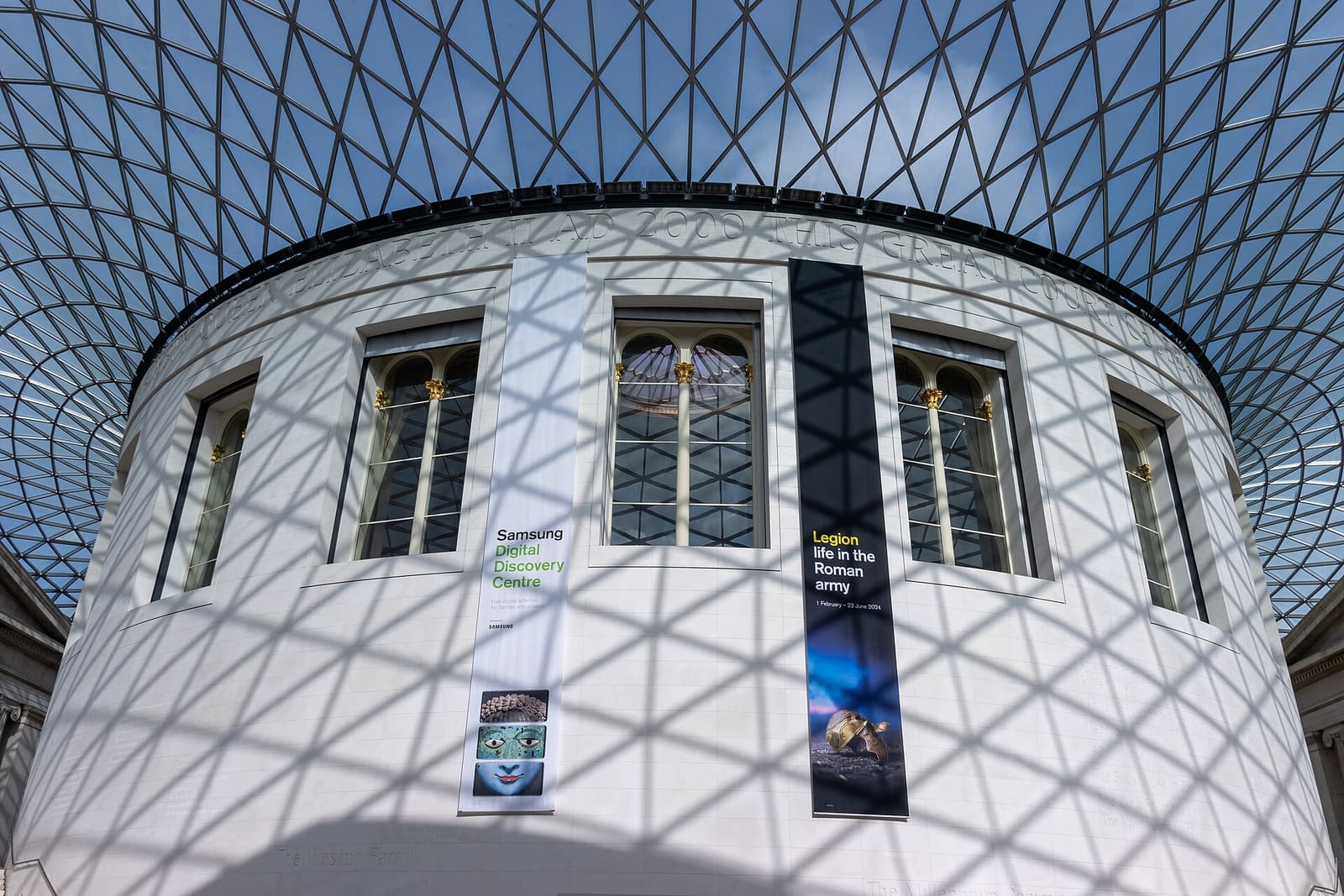
British Museum
National museum of human history and culture, free to enter.
320 m to the next stop
-

Stop 7 · Park
Bloomsbury Square Gardens
Garden square laid out in the 17th century.
340 m to Holborn station
Read the guide
A short note for each stop, written to be read or recorded as an audio walk. Audio is not available for this walk yet.
Introduction
Read the guide
This walk goes through literary Bloomsbury, from Russell Square station to Holborn station. You will visit Charles Dickens's house on Doughty Street, the Foundling Museum and an independent bookshop on Marchmont Street. Tavistock and Gordon Squares connect to the Bloomsbury Group. Then come the British Museum and Bloomsbury Square.
Stop 1: Charles Dickens Museum
Read the guide
Charles Dickens lived at forty-eight Doughty Street from March 1837 to late 1839. While here he completed The Pickwick Papers and wrote all of Oliver Twist. He also worked on Nicholas Nickleby here, and he moved on to Devonshire Terrace afterwards. Doughty Street is the only one of his London houses that survives. It became the Dickens House Museum in 1925. Next stop: the Foundling Museum.
Sources for this stop
Stop 2: Foundling Museum
Read the guide
The Foundling Museum tells the story of the Foundling Hospital. Thomas Coram set it up in 1739, after seventeen years of campaigning, to care for abandoned children. The composer Handel and the painter William Hogarth were both linked to it. The museum holds tokens that mothers left with their babies. It reopened to the public in June 2004 after a refurbishment. Next stop: Gay's The Word.
Sources for this stop
Stop 3: Gay's The Word
Read the guide
Gay's The Word is an independent bookshop on Marchmont Street. Wikipedia calls it the oldest LGBT bookshop in the United Kingdom. It opened on 17 January 1979, founded by a small group from a gay socialist group called Gay Icebreakers. In 1984 customs officers seized thousands of pounds' worth of stock. The directors were charged, and the charges were dropped in 1986. Next stop: Tavistock Square.
Sources for this stop
Stop 4: Tavistock Square
Read the guide
Tavistock Square has a statue of Mahatma Gandhi, installed in 1968. There is also a bust of Virginia Woolf, unveiled in 2004. Woolf lived at fifty-two Tavistock Square from 1924 to 1939. She and her husband Leonard ran the Hogarth Press, which published T. S. Eliot, E. M. Forster and Katherine Mansfield. On 7 July 2005 a bomb exploded on a bus outside the British Medical Association building here. A memorial was unveiled in 2018. Next stop: Gordon Square.
Sources for this stop
Stop 5: Gordon Square
Read the guide
Gordon Square was developed in the 1820s by the master builder Thomas Cubitt. It is a pair with Tavistock Square. At number forty-six, Virginia Woolf lived with her siblings, including the painter Vanessa Bell, from 1904 to 1907. The economist John Maynard Keynes lived there from 1916 to 1946. Lytton Strachey lived at number fifty-one. The University of London owns the garden and many surrounding buildings. Next stop: the British Museum.
Sources for this stop
Stop 6: British Museum
Read the guide
The British Museum was founded by an Act of Parliament approved on 7 June 1753. It was based largely on the collection of the physician Sir Hans Sloane. Its galleries and reading room opened on 15 January 1759 in Montagu House, on the present site. The building you see was designed by Sir Robert Smirke, with the west and south wings completed by 1847. The Great Court opened in December 2000. Next stop: Bloomsbury Square Gardens.
Sources for this stop
Stop 7: Bloomsbury Square Gardens
Read the guide
Bloomsbury Square was developed in the early 1660s for the fourth Earl of Southampton. It was first known as Southampton Square, and is called one of the earliest London squares. Isaac D'Israeli lived at number six from 1817 to 1829, and his son Benjamin, the future Prime Minister, lived there for part of that time. Gertrude Stein stayed at number forty in 1902. The garden has a bronze statue of Charles James Fox. The walk ends nearby at Holborn station.
Sources for this stop
Written for Britlens from the sources listed under each stop. Check opening times and access on the official sites before you go.
Getting there and back
Both ends of the walk are at stations. Check live times and any planned works before you travel.
- Museums and shops keep their own opening times: check before you go. The garden squares are open in daylight hours.
- Step-free access has not been checked for this walk. Check the route and station access before you go.
- Opening times, prices and closures change: check before you visit.
More walks
 Hyde Park and Kensington Gardens
 Battersea Park and the Power Station
 Soho and Covent Garden
 Thames Path: Westminster to Tower Bridge
Photos are credited on the photo credits page. Route and map data © OpenStreetMap contributors.