 English (UK)
 English (US)
 Français
 Deutsch
 Español
 Italiano
 Nederlands
 简体中文
Greenwich
Greenwich: Park, Observatory and Riverside
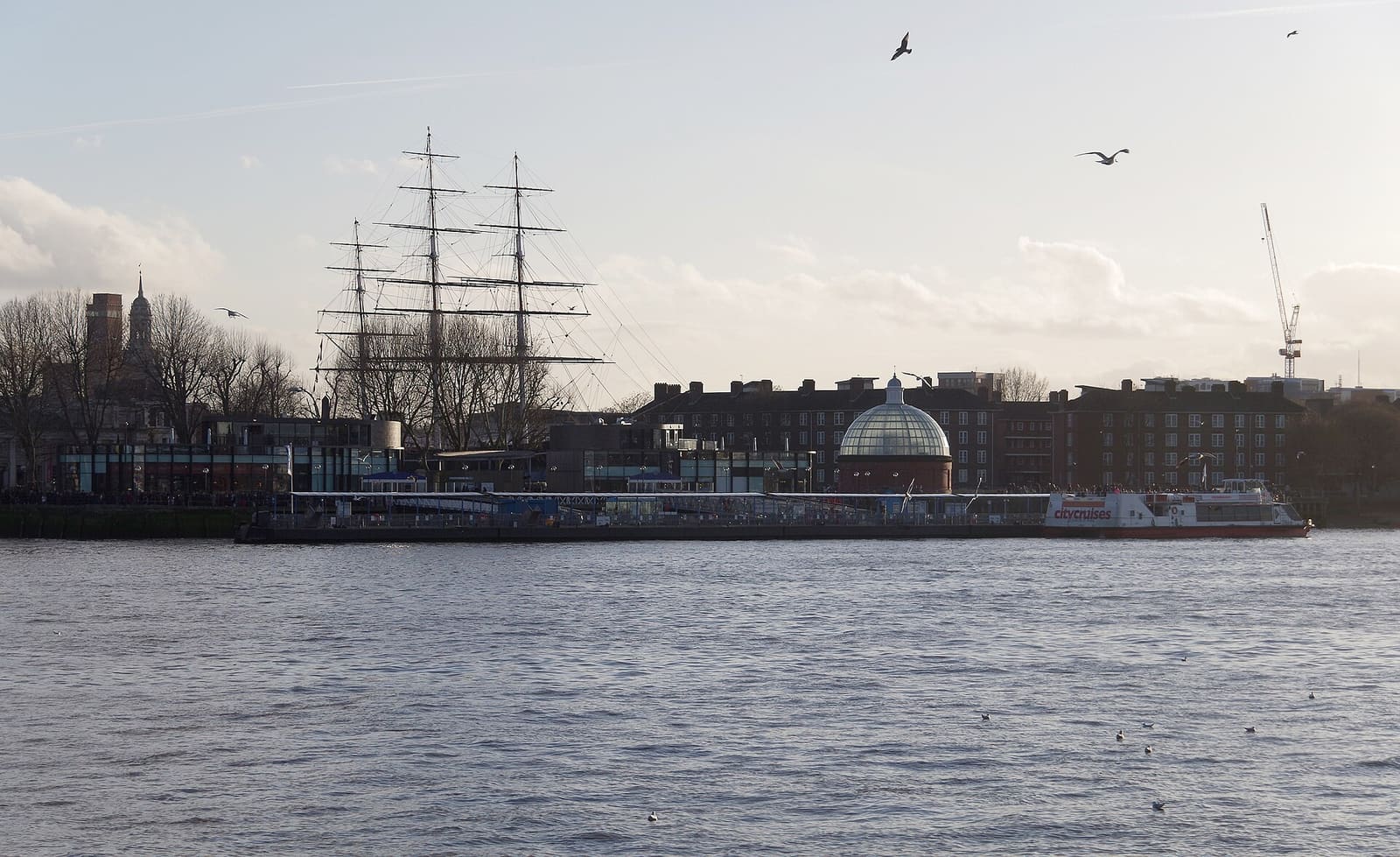
Cutty Sark, the Old Royal Naval College, the Prime Meridian and the Thames Path.
- Distance 3.9 km · 2.4 miles
- Walking time 50 min Allow 1 h 15 min for stops
- Stops7 Cutty Sark for Maritime Greenwich to Greenwich
- Terrain Some hills
- Step-freeCheck routeNot verified for this walk
Take this walk offline
The route
A loop through maritime Greenwich: the Cutty Sark, the Old Royal Naval College, the riverside path to the Trafalgar Tavern, the Queen's House and National Maritime Museum, then up through Greenwich Park to the Royal Observatory and back down to the market.
The interactive map needs JavaScript. The stops are listed below.
Stops
- Start: Cutty Sark for Maritime Greenwich
- End: Greenwich
Distance and times come from a pedestrian route between the stops. Allow extra time for stops, and check for temporary closures.
Route and map data © OpenStreetMap contributors (ODbL). Walking routes by the FOSSGIS OSRM service, saved 2026-10-18. Spotted a mistake? Fix the map.
Saved. Plan your days in My trip
Google Maps chooses its own footpaths between the stops, so its line may differ slightly from the map above. The GPX file has our route and every stop as waypoints, for use in a walking or hiking app.
7 stops, in order
Each caption is a short fact; check opening times and tickets on the official site before you go.
-

Stop 1 · Museum
Cutty Sark
Tea clipper built in 1869 and preserved in a dry dock.
350 m to the next stop
-

Stop 2 · Attraction
Old Royal Naval College
Baroque former naval college on the Thames, home of the Painted Hall.
300 m to the next stop
-
Stop 3 · Pub
Trafalgar Tavern
Riverside pub on the Thames Path in Greenwich.
490 m to the next stop
-

Stop 4 · Museum
Queen's House
Royal villa designed by Inigo Jones, now an art gallery.
230 m to the next stop
-

Stop 5 · Museum
National Maritime Museum
National museum of Britain's maritime history, beside Greenwich Park.
670 m to the next stop
-

Stop 6 · Museum
Royal Observatory Greenwich
Observatory on the hill in Greenwich Park, home of the Prime Meridian line.
880 m to the next stop
-

Stop 7 · Market
Greenwich Market
Market in the centre of Greenwich, a short walk from the Cutty Sark.
760 m to Greenwich station
Read the guide
A short note for each stop, written to be read or recorded as an audio walk. Audio is not available for this walk yet.
Introduction
Read the guide
This walk loops through maritime Greenwich. It starts at Cutty Sark station and passes the Old Royal Naval College, then follows the river to the Trafalgar Tavern. After the Queen's House and the National Maritime Museum, you climb through Greenwich Park to the Royal Observatory, then come back down to the market. It ends at Greenwich station. The climb to the Observatory is the one steep part.
Stop 1: Cutty Sark
Read the guide
Cutty Sark was built in 1869 in Dumbarton, in Scotland. Hercules Linton designed her and John Willis owned her. She was built for the China tea trade, and she was made to be fast, because merchants raced to bring the first tea home. In 1954 she was towed into a dry dock built for her here at Greenwich, and she opened to the public in 1957. A fire in 2007 burned through all three decks. She was restored and reopened in 2012. Next stop: Old Royal Naval College.
Sources for this stop
Stop 2: Old Royal Naval College
Read the guide
Queen Mary the Second founded the Royal Hospital for Seamen here, and Christopher Wren designed it. It was a refuge for elderly and injured Royal Navy sailors, and it ran from 1694 to 1869. Then it became a naval college, from 1873 until 1997. Inside is the Painted Hall. Sir James Thornhill painted it between 1707 and 1726, over more than three thousand seven hundred square metres of walls and ceilings. Lord Nelson lay in state there in 1806. Next stop: Trafalgar Tavern.
Stop 3: Trafalgar Tavern
Read the guide
The Trafalgar Tavern opened in 1837, in a Regency building by the architect Joseph Kay. In 1865 Charles Dickens set a wedding breakfast in his novel Our Mutual Friend in one of its rooms, the Hawke Room. In Victorian times the Liberal Party held whitebait dinners here. The last was in 1885, when William Gladstone's outgoing Cabinet dined. The building stopped being a pub in 1915. It later housed old sailors, and it reopened as a pub in 1965. Next stop: Queen's House.
Sources for this stop
Stop 4: Queen's House
Read the guide
Anne of Denmark, wife of James the First, commissioned the Queen's House in 1616. Inigo Jones was the architect. Work began in 1617 and stopped in 1618, with the house only partly built. Anne died in March 1619. Building started again around 1632 for Queen Henrietta Maria, wife of Charles the First. The outside was finished around 1635 and the inside by about 1638. Royal Museums Greenwich calls it the first consciously classical building in the country. Next stop: National Maritime Museum.
Sources for this stop
Stop 5: National Maritime Museum
Read the guide
In 1927 the Society for Nautical Research launched an appeal for a national naval and nautical museum. One of its members, Sir James Caird, bought a collection of more than eleven thousand maritime prints, along with ship models and other items, to start it off. Rudyard Kipling suggested the name. King George the Sixth opened the National Maritime Museum on 27 April 1937. The Sammy Ofer Wing opened in 2011, the largest development in the museum's history so far. Next stop: Royal Observatory Greenwich.
Sources for this stop
Stop 6: Royal Observatory Greenwich
Read the guide
On 4 March 1675 Charles the Second appointed John Flamsteed as his astronomical observator, a post later called Astronomer Royal. In June the king ordered a small observatory built on high ground in the royal park. Christopher Wren designed it. Flamsteed laid the foundation stone on 10 August 1675 and moved in on 10 July 1676. In 1884 the International Meridian Conference chose Greenwich as the Prime Meridian, the zero line of longitude for the world. Next stop: Greenwich Market.
Sources for this stop
Stop 7: Greenwich Market
Read the guide
Market stalls were trading in Greenwich as early as the fourteenth century. A royal charter in December 1700 set the market on a regulated footing, and it officially opened on 3 September 1737. In 1902 the old timber roof was replaced with three glazed roofs held up by steel trusses. Those roofs were restored in 2016, which helped the market earn its Grade Two listing. The walk ends here, close to Greenwich station.
Sources for this stop
Written for Britlens from the sources listed under each stop. Check opening times and access on the official sites before you go.
Getting there and back
Both ends of the walk are at stations. Check live times and any planned works before you travel.
- The climb to the Royal Observatory is the one steep section. Museum and ticketed-site opening times vary: check before you go.
- Step-free access has not been checked for this walk. Check the route and station access before you go.
- Opening times, prices and closures change: check before you visit.
More walks
 Notting Hill, Portobello and Holland Park
 Hampstead Heath and Kenwood
 Royal London: St James's to Whitehall
 The City and Roman London
Photos are credited on the photo credits page. Route and map data © OpenStreetMap contributors.